
Jane Austen in Bath: Places to Visit, Her History & the Perfect Literary Day

Tracing Jane Austen through Bath? From the Jane Austen Centre and the addresses where she actually lived to the Pump Room, Milsom Street, Gravel Walk and Sydney Gardens, here’s everything you need to have the perfect literary day in Bath.
This post may contain affiliate links. Check out my Disclosure & Privacy Policy for more information.
The first time I came to Bath, I was half-looking for Catherine Morland.
Not literally, obviously. But I’d known Bath for years through Jane Austen: assembly rooms, Milsom Street, the Pump Room, people going for walks that somehow became major plot developments and entire social worlds built around who had been introduced to whom.

So when I finally visited after moving from the East Coast of the US to the UK in 2016, it was a little surreal seeing all that Regency imagination turn into an actual city of pale stone terraces, hills and absurdly beautiful crescents.
I’ve been back countless times since—solo, with my mum, with friends and through my work as a travel writer. Somewhere along the way, I fell in love with the Jane Austen Centre, had afternoon tea beneath the chandeliers at The Pump Room Restaurant and aimlessly wandered past all the addresses where Austen actually lived.
But Jane Austen’s Bath wasn’t simply balls, bonnets and eligible bachelors. She lived here from 1801 to 1806, moved through increasingly modest addresses after her father died, wrote surprisingly little during those years and still managed to turn Bath into one of the sharpest social settings in English fiction.
You can still see an extraordinary amount of it: the street where she lived, the gardens outside her door, the rooms where Bath society danced, the shopping streets her characters wandered and the Pump Room where being spotted by the right person could make or break your reality.
All the Georgian drama aside, here’s how to have a spectacular Jane Austen day in Bath for yourself.
Shall we?

Jane Austen Tours in Bath
Prefer to explore with a guide? Try the private Jane Austen tour for the best overall introduction to Austen’s Bath, the Gothic twilight tour for Northanger Abbey fans, or the Regency dress & afternoon tea experience for a full Regency experience.

About the Author
Hi, I’m Candace — a London-based travel writer and content creator who traded the East Coast of the US for the charm of the UK back in 2016. London’s been my home ever since.
On this blog, you’ll find hundreds of thoughtfully crafted London, UK, Europe and Worldwide travel guides alongside lots of insider London tips, honest hotel and restaurant reviews and advice for content creators.
P.S. – For more trip inspiration, travel videos, and behind-the-scenes adventures, be sure to follow along (and say hello, if you fancy) on Instagram, TikTok or YouTube.
🗞️📺 As featured on the BBC, USA Today & Recipe.TV.
Quick Overview: Jane Austen in Bath

| Question | Quick answer (fire-round!) |
|---|---|
| Did Jane Austen live in Bath? | Yes. She lived in Bath from 1801 to 1806. |
| Was Jane Austen born in Bath? | No. She was born in Steventon, Hampshire, in 1775. |
| Which Jane Austen books feature Bath? | Northanger Abbey and Persuasion. |
| Is the Jane Austen Centre her house? | No. The Jane Austen Centre is at 40 Gay Street. Austen briefly lived nearby at 25 Gay Street. |
| Where did Jane Austen live in Bath? | Her best-known address is 4 Sydney Place, where the family lived from 1801 to 1804. |
| Best place to start your Jane Austen pilgrimage | The Jane Austen Centre. |
| Best Jane Austen guided tour | The Strictly Jane Austen private walking tour for 2.5 hours of Austen and Regency Bath with an expert guide. |
| Best real Austen stop | 4 Sydney Place and neighbouring Sydney Gardens. |
| Best literary stop | Gravel Walk for Persuasion. |
| Best Austen afternoon tea | The Pump Room Restaurant for history; the Regency Tea Room for full Austen theming. |
| Best time to visit for the Jane Austen Festival | September. Check this year’s dates! |
| How much time do you need? | A full day for the main Austen places; two days if you want the rest of Bath too. |
Plan Your Bath Trip
Where I recommend staying: For the most character, I’d choose No.15 by GuestHouse, Bath, set inside three Georgian townhouses on Great Pulteney Street with playful interiors and an on-site spa. For the easiest arrival by train, I’d stay at Hotel Indigo Bath; it’s a 5-minute walk from Bath Spa station with small Jane Austen touches alongside a modern stay. I’ve personally stayed at and highly recommend both.
Getting to Bath from London: Compare times and book your direct journey from London Paddington to Bath Spa—it takes around 1 hour 15 minutes and is a beautiful journey.
The attraction I’d book first: Reserve your Roman Baths entry ticket with audio guide. It’s an essential first-time Bath attraction, and arrival times can fill up quickly on busy weekends and holidays.
Visiting from London for the day? I’d choose this Windsor, Stonehenge, Bath and Roman Baths day tour if you want transport and all major bookings handled for you.
Staying longer? This Stonehenge, Avebury, Lacock and Castle Combe tour from Bath combines two prehistoric sites with two of the prettiest villages within easy reach of the city.
For a different view: Take this 30-minute scenic River Avon cruise for glorious views over Bath’s weir and riverside.
Stay connected: Set up your UK eSIM before your trip. It takes less than five minutes, and you’ll have mobile data ready to use when you arrive.
For extra peace of mind: I personally recommend using VisitorsCoverage to compare travel insurance options before your trip—it’s my go-to for finding the right cover whenever I travel.
Why Is Jane Austen So Connected to Bath?

Jane’s history in Bath might surprise you: she moved here permanently in 1801 because her father retired—in other words, not because she was chasing literary inspiration in a glamorous spa town.
She was 25 when Reverend George Austen moved the family from Steventon in Hampshire to a city already famous for its thermal waters and even more famous for the people who came to be seen taking them.
At first, the Austens had a rather lovely address at 4 Sydney Place, directly opposite Sydney Gardens. They stayed there until 1804 before moving to Green Park Buildings.
Then George Austen died in January 1805. Jane, Cassandra and their mother were left with less money and the addresses changed with it: first 25 Gay Street, then cheaper lodgings in Trim Street, before they finally left Bath in 1806.
Keep in mind, this was a city where rank and money could be read in an address, and Austen spent her career essentially making fun of exactly that kind of social code. Bath made for great material.
Did Jane Austen Like Bath?

Probably not in the simple love-it-or-hate-it way the internet would prefer.
There are surviving letters in which Austen sounds pleased by walks and by having Sydney Gardens close by. But her Bath years also brought repeated moves, tighter finances and the death of her father.
Her novels give a much better sense of her ambivalence. Catherine Morland arrives in Northanger Abbey ready to find Bath thrilling. Anne Elliot in Persuasion sees the same world with far fewer illusions. Put them together and you get a city Austen clearly understood from both sides: the fun of it and the performance of it all.
Did Jane Austen Write in Bath?
Yes, but not nearly as much as the Bath connection sometimes suggests.
The manuscript that eventually became Northanger Abbey—then called Susan—was already written before Austen moved permanently to Bath. It was sold to a publisher in 1803 and then, rather painfully, sat unpublished.
Austen began the unfinished The Watsons around the middle of her Bath years. Persuasion came much later, after she had settled in Chawton.
A Jane Austen Day in Bath

Bath makes a literary day wonderfully easy. Most of the main Austen places sit within a compact stretch of the centre, with the only real effort coming from the city’s hills (so wear comfortable shoes).
If you’re trying to see the whole city in the same visit, my one-day Bath itinerary mixes Austen with the Roman Baths, Abbey and Georgian highlights.
For a slower weekend, use my two-day Bath itinerary.
1. Jane Austen Centre and Gay Street


Forty Gay Street is where you’ll be dosed in all things Jane Austen in Bath.
The Jane Austen Centre opens with a live character presentation before moving through Austen’s family, her Bath years, Regency fashion and the social habits behind the novels. It’s interactive, a little theatrical and very easy to enjoy.
It’s quite simply one of the best Jane Austen things to do in Bath, but the important catch is that the Centre was never Jane Austen’s home.


She did live on Gay Street, though—at 25 Gay Street, a short walk uphill from the Centre, for several months after her father died (it’s still a private building, so best to look from the pavement and keep it moving).
Upstairs at the Centre, the Regency Tea Room serves the full themed afternoon-tea experience, and there’s a Jane Austen shop for books, stationery and appropriately excessive Austen souvenirs.
2. Bath Assembly Rooms

Continue uphill to the Bath Assembly Rooms, completed in 1771 to designs by John Wood the Younger.
This was Georgian Bath showing off: balls, concerts, card games, conversation and whole evenings devoted to the business of being visible in the right room.
In Northanger Abbey, Catherine Morland comes to the Upper Rooms to dance, meet people and discover that even a crowded ballroom can be painfully lonely when nobody asks you onto the floor.
Austen attended assemblies herself, so the scenes have the slightly wicked accuracy of someone who knew exactly how these rooms worked.
When not under renovation!
3. Gravel Walk and the Royal Crescent

From the Assembly Rooms, wander towards The Circus and pick up the Gravel Walk.
This tree-lined path was laid out in the 18th century for promenading and is forever tied to the final Bath chapters of Persuasion, when Anne Elliot and Captain Wentworth finally get the conversation they’ve spent most of the novel failing to have.
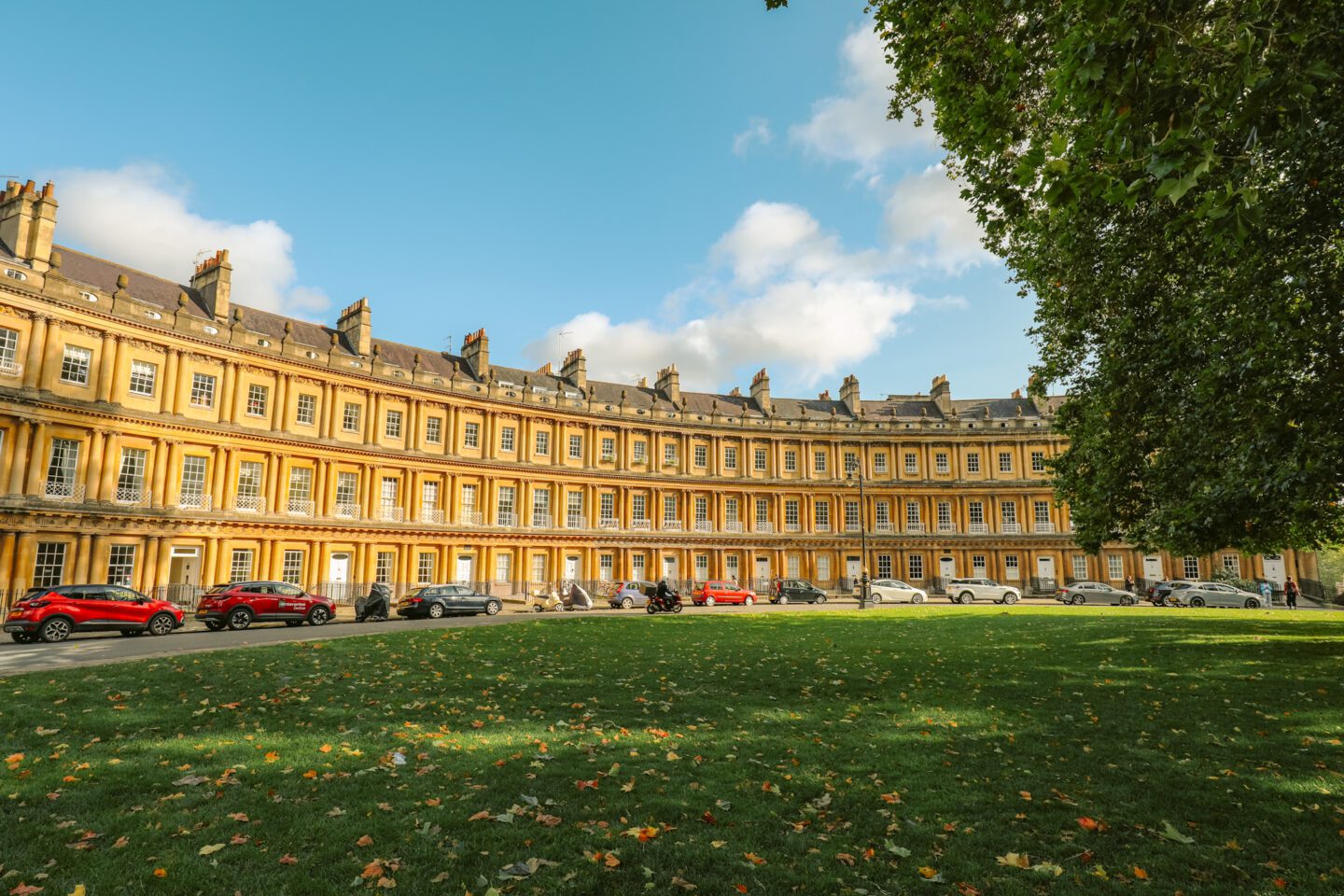
It’s one of my favourite Austen places in the city and a walk that’ll bring you close to the Royal Crescent. Austen didn’t live here, but the 30-house sweep is still one of the best peeks at the wealthy Georgian Bath she wrote about.
For interiors, visit No.1 Royal Crescent to see the inside of a fashionable Georgian townhouse with drawing rooms, bedrooms, kitchens and servants’ spaces. Well worth visiting if the domestic world behind Austen’s characters interests you as much as the plot.
For coffee nearby, visit The Green Bird Café between The Circus and Royal Crescent. For more coffee, brunch and cake options, use my best cafés in Bath guide.
P.S. – If the façades are also giving you immediate Bridgerton déjà vu, you’re not imagining it. Bridgerton filming locations in Bath use many of the same Georgian streets for the show!
4. Queen Square and Milsom Street

Walk back down through Queen Square, one of John Wood the Elder’s early statements in Bath, then carry on to Milsom Street.
Milsom Street opened in 1762 and was already fashionable shopping territory by Austen’s day. Catherine Morland and Isabella Thorpe talk clothes and shops around this world in Northanger Abbey, while Anne Elliot unexpectedly sees Captain Wentworth on Milsom Street in Persuasion.
Two centuries later, it’s still a shopping street—which feels wonderfully appropriate. And more than enough reason to take up a spot of Bath shopping here yourself…
5. The Pump Room

By this point, afternoon tea at The Pump Room Restaurant is a must.
I’ve had it twice and it’s still one of my favourite places to eat and exist in Bath. The room is gloriously grand: chandeliers, tall columns, huge windows and live classical music floating over tiers of sandwiches, cakes and scones.
But this isn’t just an Austen connection invented for tourists. The Pump Room was actually one of Georgian Bath’s great social meeting places, sitting beside the thermal springs and drawing the same fashionable visitors who filled the city’s balls and promenades.
And the tea here is lovely!


Pump Room or Regency Tea Room? I’d go to The Regency Tea Room for the more overtly Austen-themed choice. The Pump Room wins for me, as the room itself is historically part of Austen’s Bath.
6. Pulteney Bridge, Great Pulteney Street and 4 Sydney Place

After tea, cross Pulteney Bridge and walk straight along Great Pulteney Street.
Around the Abbey you’ll find lanes of medieval fragments, widened pavements and Georgian terraces that stretch almost theatrically towards the east side of the city.
At the far end is 4 Sydney Place.
This is where Jane Austen lived from 1801 to 1804, with a plaque on the exterior to prove it (but the property is private, so just good for a quick stop).
7. Sydney Gardens

Directly opposite the house, Sydney Gardens was effectively Austen’s local park.
The gardens opened in 1795 as a pleasure garden, with public breakfasts, concerts, fireworks and promenades. Austen mentioned them in her letters and seems to have enjoyed having them almost on the doorstep.
They’re much calmer now: with lawns, mature trees, bridges and the Kennet and Avon Canal running through the grounds, and a lovely place for a respite after several hours of Jane Austen exploring.
P.S. – You can also visit the Holburne Museum right nearby; which, if you’re a Bridgerton fan, you’ll recognise instantly as the exterior of Lady Danbury’s house.
8. Finish With a Bath Bookshop

There’s no sensible way for me to write about a literary day in Bath and send you home without a bookshop.
Topping & Company Booksellers is a glorious one, with tall shelves, reading spaces and book ladders—a reader’s dream.
Mr B’s Emporium of Reading Delights is quirkier, spread across several rooms and known for its Reading Spa, where a bookseller builds a personalised stack around your tastes.
Or for an entirely bookish weekend, read my best bookshops in Bath guide.
Other Jane Austen Places in Bath

St Swithin’s Church, Green Park Buildings and Trim Street
The turn of Austen’s Bath life sits just north of the centre at St Swithin’s Church in Walcot.
Jane’s father, Reverend George Austen, died in Bath on 21 January 1805 and was buried here. His death changed the family’s finances almost immediately, and the women later moved to cheaper lodgings at Green Park Buildings and on Trim Street.
Which Jane Austen Books Feature Bath?
Northanger Abbey
Northanger Abbey is Austen’s funnier Bath novel, where Catherine Morland arrives at 17 with Mr and Mrs Allen and is deeply concerned with everything from the balls and the clothes to who you spoke to at said ball in said clothes.
The Pump Room, Assembly Rooms, Milsom Street and Pulteney Street all sit inside Catherine’s version of the city, which makes the novel ridiculously satisfying to reread before a trip.
Persuasion
Persuasion is a bit of the opposite, where Anne Elliot arrives older, quieter and considerably less interested in being dazzled by fashionable society. The Elliots care deeply about appearances, but Anne mostly watches the consequences.
Gay Street, Milsom Street, the Pump Room and Gravel Walk all play backdrop to the antidote to Catherine’s first-season excitement. So make sure you read both before your trip!
Is the Jane Austen Centre in Bath Worth Visiting?

Yes—with one important caveat.
The Jane Austen Centre is not Jane Austen’s preserved house, so I wouldn’t go expecting original rooms frozen in time or anything of the sort.
It does, however, bring Jane Austen’s Bath to life well. I really enjoyed the live presentation, the exhibition is easy to follow and there’s lots of interactive Regency bits like costumes and letter writing to take part in before you head back onto Gay Street.
If you’re a serious Austen scholar, you may want something deeper. If you’re a reader, adaptation fan or simply curious about why Bath is so tied to her, I think it’s a very fun hour.
P.S. – The actual preserved Jane Austen’s House is in Chawton, Hampshire, where she moved in 1809 and spent the most settled writing years of her life.
The Best Jane Austen Tours in Bath

You can absolutely follow the Jane Austen day below independently. But if you want the social rules, literary references and bits of Regency Bath you’d never think to look for explained as you walk, this is one of those cities where having a specialist ‘Jane Austen guide’ can add a lot.
1. Private Guided Tour of Jane Austen’s Bath — Best Overall
If Jane Austen is the main reason you’re in Bath, this is the one I’d look at first.
The private Jane Austen walking tour lasts 2.5 hours and starts outside the west doors of Bath Abbey, with a guide that’ll waltz you through the world of Regency social etiquette, what life was like for women at the time, what fashionable Bath expected of its visitors and how the city’s streets, promenades and public rooms actually functioned.
2. Jane Austen & Bath’s Gothic History Twilight Tour — Best for Northanger Abbey Fans
This is the much more atmospheric option if Northanger Abbey is your Austen novel.
The Gothic twilight walking tour runs for 2.5 hours at 4pm and moves beyond Austen into the Gothic Bath surrounding her work: Ann Radcliffe, Mary Shelley, the city’s darker architecture and the literary obsessions Austen was very knowingly poking fun at through Catherine Morland.
3. Regency Dress Hire & Afternoon Tea — Best for the Full Experience
If reading about promenading around Bath has left you wanting to do it for yourself, there’s also a rather fabulous Regency dress hire and afternoon-tea experience.
Your costume is arranged in advance and delivered to your Bath accommodation, followed by afternoon tea at The Gainsborough Bath Spa.
You can also add an expert guided Bath walk, including the option for the guide to join you in costume. Not essential for seeing Austen’s Bath, obviously—but if your idea of a literary trip includes actually stepping into the Regency world for an afternoon, it’s absolutely the most immersive (and fun) of the three.
The Jane Austen Festival in Bath

If there’s any time to visit Bath as an Austen fan, it’s September…for the Jane Austen Festival!
Every year the streets fill with balls, talks, dances, walking tours, workshops, performances, Regency tea and a glorious amount of Georgian bonnets.
The big one to note is the Grand Regency Costumed Promenade, where around 2,000 people in Regency costume take to the streets, gathering around the Royal Crescent before processing through Bath.
You can watch the Grand Regency promenade without dressing up or join in on the action (in your best Regency dress, of course, here’s how to take part).
P.S. – If you’re visiting Bath during The Jane Austen Festival, make sure you book your hotel far in advance; they sell out fast!
Where to Stay for a Jane Austen Trip to Bath


For an Austen-heavy trip, I’d choose Hotel Indigo Bath.
It’s just a 5-minute walk to Bath Spa station, with a lovely breakfast and contemporary nods to the city’s Georgian and Jane Austen history throughout the property. Read my Hotel Indigo Bath review for my full take!
Otherwise, you can absolutely do Jane Austen’s Bath as a day trip. But if you also want the Roman Baths, a soak at Thermae Bath Spa and dinner without checking your train times every 20 minutes, stay the night.
Practical Tips for Visiting Jane Austen’s Bath
- Book the Centre before busy weekends. The Jane Austen Centre is one of Bath’s obvious attractions, especially during summer and the September Festival.
- Give the Centre around an hour. Add longer if you’re staying upstairs for the Regency Tea Room.
- Remember that Austen’s old homes are private. Gay Street and Sydney Place are exterior stops, so always be respectful.
- Expect hills. Gay Street, the Assembly Rooms and Royal Crescent sit above the Roman centre, so you’ll absolutely need comfortable shoes.
- Plan well in advance if you’re coming for the Jane Austen Festival. Sort your hotel and Regency outfit, and book balls and specialist talks early, as availability can disappear well before September!
- And your train tickets from London to Bath if you’re coming from the capital
Final Thoughts on Jane Austen in Bath


Jane Austen was the reason I first wanted to see Bath. And the more I’ve returned, the more special it feels to see so much of the city that shaped her world still standing.
Austen knew Bath from far more than one angle—from its grand streets, pleasure gardens and fashionable rooms, to the areas she moved after her family’s circumstances shifted.
And that’s precisely what makes Bath so wonderful if you’re a Jane Austen fan. You can walk through Catherine Morland’s excitement and Anne Elliot’s scepticism all in one afternoon. And of course, do some incredible Bath exploring along the way.
Wishing you the best Jane Austen day in Bath!
Happy travels,
Candace x
FAQ: Jane Austen in Bath
What Is the Relationship Between Jane Austen and Bath?
Jane Austen visited Bath before moving there with her family in 1801 and lived in the city until 1806. Bath later became a major setting in Northanger Abbey and Persuasion, with its assemblies, shops, streets, lodgings and social life woven throughout both novels.
Was Jane Austen Born in Bath?
No. Jane Austen was born in Steventon, Hampshire, on 16 December 1775. She knew Bath from earlier visits and lived there for five years as an adult.
Where Did Jane Austen Live in Bath?
Her best-known Bath home is 4 Sydney Place, where the family lived from 1801 to 1804. They later lived at Green Park Buildings, 25 Gay Street and Trim Street before leaving Bath in 1806.
Did Jane Austen Like Bath?
Her feelings seem to have been mixed. Austen enjoyed parts of Bath, including walks and Sydney Gardens, but her years there also included several moves, tighter finances and the death of her father. Too few letters from the period survive to reduce her relationship with the city to a simple love-or-hate answer.
Did Jane Austen Write in Bath?
She wrote relatively little during the years she lived in Bath. The manuscript that became Northanger Abbey had been drafted before the permanent move, while Austen began the unfinished The Watsons around 1804. Persuasion was written years later at Chawton.
Which Jane Austen Books Are Set in Bath?
Northanger Abbey and Persuasion both use Bath as a major setting. Catherine Morland experiences the city through balls, shopping and new friendships in Northanger Abbey; Anne Elliot returns to a more status-conscious, emotionally complicated Bath in Persuasion.
Is the Jane Austen Centre Her House?
No. The Jane Austen Centre is an interpretive attraction at 40 Gay Street. Austen briefly lived nearby at 25 Gay Street. Her preserved home, Jane Austen’s House, is in Chawton, Hampshire.
Is the Jane Austen Centre in Bath Worth It?
Yes. I especially love the live presentation and interactive bits. It’s a really fun introduction to Austen’s Bath years and Regency life (just don’t expect a preserved former home).
Are There Jane Austen Walking Tours in Bath?
Yes. For a specialist option, Strictly Jane Austen’s private guided walking tour lasts 2.5 hours and focuses specifically on Austen’s life, Regency society and the Bath she knew. They also offer a Gothic literary twilight tour that works especially well for Northanger Abbey fans.
When Is the Jane Austen Festival in Bath?
The Jane Austen Festival runs every year in mid-September, and the Grand Regency Costumed Promenade usually takes place on the Saturday. Check this year’s official dates here!
Can You Watch the Grand Regency Costumed Promenade Without Dressing Up?
Yes. Watching the Grand Regency Costumed Promenade is free along the route. To join the official procession, you need the event wristband and suitable Regency costume. See how to join here.
Did Jane Austen Die in Bath?
No. Jane Austen left Bath in 1806 and died in Winchester on 18 July 1817, aged 41, after moving there for medical treatment.
Is Jane Austen Buried in Bath?
No. Jane Austen is buried in the north aisle of Winchester Cathedral. Her father, Reverend George Austen, is buried at St Swithin’s Church in Bath.
What Are the Best UK Places for Jane Austen Fans?
Bath, Chawton and Winchester are the best trio, I’d say. Bath gives you the streets and social world of Northanger Abbey and Persuasion; Jane Austen’s House in Chawton preserves the cottage where she spent her final settled years; and Winchester Cathedral is where she’s buried.
Plan the Rest of Your Bath Trip
Still planning? Here’s more of my Bath guides to help you decide where to stay, what to book and how to make the most of your trip.

Bath itineraries and planning
- The Best Things to Do in Bath, England: Roman Baths, Georgian Streets, Jane Austen & More
- 2 Days in Bath: The Perfect Weekend Itinerary (From a Frequent Visitor)
- One Day in Bath: The Perfect Day Trip Itinerary (With Map & Tips)
- How to Get from London to Bath: Train, Bus, Car or Tour?
- Christmas in Bath: The Perfect Festive Weekend Itinerary
What to see and do in Bath
- Bridgerton Filming Locations in Bath: A Self-Guided Walking Tour + Visiting Tips
- Jane Austen in Bath: Places to Visit, Her History & the Perfect Literary Day
- The Best Bookshops in Bath, England: A Literary Day Out for Book Lovers
- The Roman Baths in Bath, England: Everything You Need to Know Before You Visit
Where to stay in Bath
- The Best Hotels in Bath, England: Where to Stay, From Georgian Townhouses to Spa Hotels
- No.15 by GuestHouse Bath Review: Is This Characterful Georgian Hotel Worth It?
- Hotel Indigo Bath Review: A Jane Austen-Inspired Stay Near Bath Spa Station
Tours, day trips and experiences
- The Best Walking Tours in Bath: History, Bridgerton, Ghost & Food Tours
- The Best Bath Day Tours from London: Stonehenge, Windsor, Lacock & More
- The Best Day Trips from Bath: Cotswolds, Stonehenge, Oxford & More
- Thermae Bath Spa Review: Is It Worth It? Everything You Need to Know
- The Best Boat Trips in Bath, England: Sightseeing, Prosecco Cruises & River Avon Views


