
Tanzania Safari Guide (2026): First-Hand Safari Itinerary, Top Tips & Must-Sees

Looking to do safari in Tanzania? Going on safari in Tanzania was one of the best trips and life experiences I’ve had to date. Here’s my first-hand itinerary and experience, guide recommendations, tips and must-sees to have a once-in-a-lifetime trip here, too. From someone who’s done it!
This post may contain affiliate links. Check out my Disclosure & Privacy Policy for more information.
There are few experiences that have truly changed the way I see travel — but going on safari in Tanzania was one of them.
It was my first time in Tanzania, my first time in Africa, and my very first safari. Honestly, I had no idea what to expect.
But it didn’t take long for it to become one of my favourite travel experiences of all time.


Unlike the typical UK & Europe adventures I write about, doing safari takes a lot of pre-planning and coordination—and cannot be done alone in the same way you can hop over on a solo trip to Paris or a first time visit to London.

So without further ado, here’s my first-hand experience of safari in Tanzania including:
- 🗺️ A full day-by-day breakdown of my actual itinerary, so you can plan yours
- 🐘 What it’s really like being on safari in Tanzania — from early wake-ups to wild animal encounters
- 📍 The must-visit parks I explored, including the Serengeti, Ngorongoro Crater, and more
- 🎒 A practical packing list (and the things I wish I hadn’t forgotten!)
- 💡 Real tips I learned on the ground — plus what I’d do differently next time
- ✈️ All the travel logistics you need: when to go, how much it costs, and how to get there
- ❓ Safari FAQs & more!
…to have what can only be described as a once-in-a-lifetime trip. Shall we?

About the Author
Hi, I’m Candace — a London-based travel writer and content creator who traded the East Coast of the US for the charm of the UK back in 2016. London’s been my home ever since.
On this blog, you’ll find hundreds of thoughtfully crafted London, UK, Europe and Worldwide travel guides alongside lots of insider London tips, honest hotel and restaurant reviews and advice for content creators.
P.S. – For more trip inspiration, travel videos, and behind-the-scenes adventures, be sure to follow along (and say hello, if you fancy) on Instagram, TikTok or YouTube.
🗞️📺As featured on the BBC, USA Today & Recipe.TV.
Why Tanzania? (+ When to Go)

Before heading off on safari in Tanzania, you might be wondering — why choose Tanzania in the first place?
While there are plenty of amazing countries to go on safari, we chose Tanzania for a few specific reasons.
One rather unique one…my friend actually lives there — her husband runs a football programme for local children through FIFA (yes, the coolest job ever!).
But beyond that, Tanzania is home to the iconic Serengeti (yes, the Serengeti from The Lion King) and is known for its warm hospitality, rich wildlife, and reputation for being one of the safer countries for safari travel.

We timed our visit to catch the breathtaking Great Migration river crossing (which you may also recognise from The Lion King) — a natural spectacle where thousands of wildebeest and zebras cross the Mara River, often dodging crocodiles in the process.

This usually takes place between July and September, when the animals move from the Serengeti in Tanzania to the Masai Mara in Kenya in search of greener pastures.
But otherwise, June to October is a fantastic time to go too — it’s the dry season, meaning fewer mosquitoes, animals gathering around waterholes, and clearer skies for wildlife spotting and photos too.
IMPORTANT Things to Know Before You Go on Safari

🌅 Safari days start early — think sunrise wake-ups, long (sometimes bumpy) drives, and hours in the Jeep — but trust me, the wildlife sightings and golden-hour views make it more than worth it.
🦟 Bring mosquito repellent + take your malaria tablets — especially important if you’re combining safari with Zanzibar.
💵 Tipping is expected for drivers and guides — around $10–$20 USD or £8 – £15 per person per day is standard. You’ll typically tip in an envelope at the end of the trip.
🚙 Most safaris are long days in a 4×4 vehicle with lots of driving (sometimes 12 hours!) — bring layers, snacks, and something to read or listen to if you get antsy.
📶 WiFi is limited or nonexistent in many lodges — so make sure to download anything you need in advance and get an eSIM for Tanzania before your trip.
📸 Binoculars are a game-changer, some guides will have one on hand, but I suggest bringing your own just in case to make it easier (and cooler) to spot animals far off.
🚽 Bathroom breaks are few and far between during game drives — be prepared for the odd bush stop if needed!
🌿 Park fees add up — most national parks charge per 24-hour entry, so if you’re budgeting DIY-style, keep that in mind.
🍽️ Food on safari: Most safari days include a packed lunch from your lodge or guide, which you’ll eat during a mid-day break at one of the designated picnic spots inside the park (expect a proper box with sandwiches, fruit, juice, etc.).
Breakfast is usually served super early before your drive, and dinner is back at the lodge after a long day out. Everything’s sorted for you — so no need to think about food logistics at all, but if you have allergens be sure to let them know, before your safari so they can prepare.
🏕️ Safari accommodation ranges from basic campsites to ultra-luxury lodges — we stayed in a mix of mid-luxury to luxury tented camps, which came with full-board meals, en-suite bathrooms, and all the comforts you’d want after a long day on game drive. You’ll find all the places we stayed in the itinerary below!
Planning Your Safari: Local vs Tour Package

One of the best parts of our trip? It was completely custom.
Thanks to our local contact Leia (she’s originally from London but now runs an amazing events and travel company in Tanzania) we were able to plan the trip exactly how we wanted it. Private driver, full flexibility, and zero big group tours or rigid schedules.
Highly recommend her! You can WhatsApp Leia at +255 750 866 470 and mention I sent you if you’d like help planning your own Tanzania adventure.
If you’re after a more traditional package or prefer booking through a safari company direct, here are a few trusted operators to check out:
🛻 Asilia Africa – Eco-conscious and beautifully styled camps across Tanzania
🛻 Nomad Tanzania – High-end, authentic safari experiences
🛻 Easy Travel Tanzania – Great for custom and mid-range itineraries
🛻 Rough Guides Tailor-Made Trips – For a more curated safari package
Please note that all safari experiences and itineraries differ, so just take mine as a rough/example guide of what you can get up to!
Safari is not a cheap travel experience — and honestly, it shouldn’t be. Between park fees, guides, accommodation, transport, and food, it adds up quickly.
We spent around $,6,000 USD / £4,500 GBP each, which included a mix of mid-range to luxury accommodation, a private guide, all our meals, domestic flights, and hotels.
You can absolutely spend less (especially if you go group-style or budget lodges), but for a smooth, personalised trip — this is a good ballpark. And trust me: safari is worth every penny.
A Note on “The Big Five” 🐘🦁🐆🦏🐃

Once phrase you’ll hear a lot when it comes to safari is ‘The Big Five‘ — referring to the five most iconic animals to see on safari:
- Lion
- Leopard
- Elephant
- Rhinoceros
- Cape Buffalo
They’re not just big — the term actually comes from how dangerous they were to hunt back in the day. Thankfully, the only shooting now is with your camera…
It’s important to note that you’re not guaranteed to see the big five on your trip — although Lions and Elephants will be the easiest to find.
But beyond ticking off a list, the magic of safari is in the unexpected moments — from a herd of elephants crossing your path at golden hour to watching a pride of lions snoozing in the shade (or if you’re lucky, hunting!).
So don’t stress too much about “seeing it all”. And remember you’ll be seeing hundreds of animals during your trip, including:
- Giraffes – especially in Serengeti
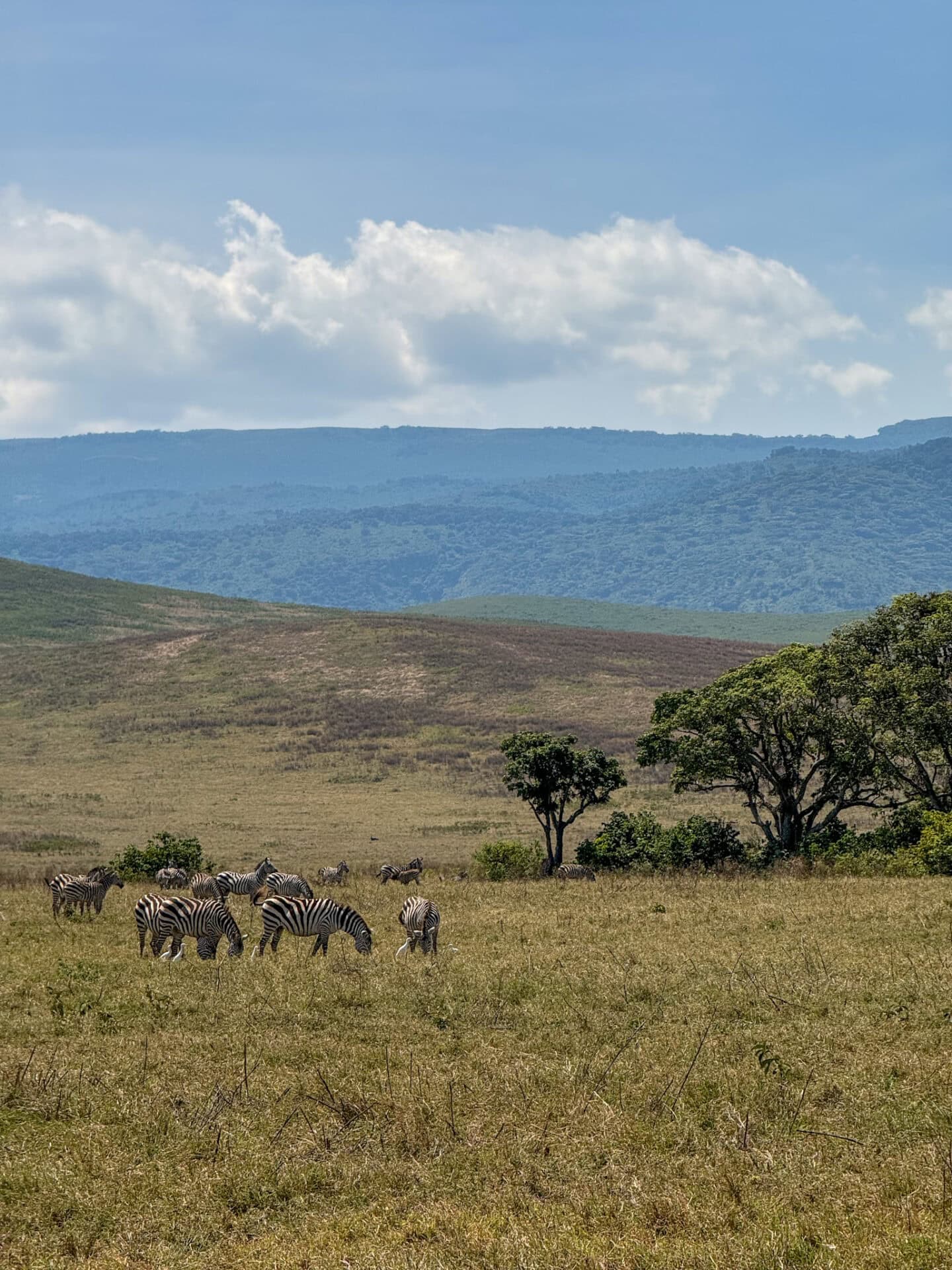
- Zebras & Wildebeest – everywhere, but especially abundant in the Ngorongoro Crater
- Baboons & Monkeys – even in the car park…
- Hippos – at the Serengeti hippo pools
- Hyenas, jackals, warthogs, and more!
My Tanzania Safari Itinerary (6-Day Breakdown)

Day 1: Arrival in Arusha, Tanzania 🇹🇿✈️

We kicked off our trip flying from London to Zanzibar Airport via Qatar Airways, with a quick layover in Doha.
From there we spent 4 days in Zanzibar to go from ‘beaches to bush’ as they say, then took a short flight to Arusha to begin safari.
If you’re skipping Zanzibar and going straight into safari, fly into Dar es Salaam, then take a quick domestic flight to Arusha — the main safari hub for Northern Tanzania.
✈️ Flight times: From London, it’s around 10–11 hours to Tanzania (with a layover). From New York, you’re looking at roughly 14–16 hours, depending on your route. Bring a great neck pillow!


If you’re keen to start your trip in Zanzibar then go on safari (or safari then Zanzibar) be sure to check out my Zanzibar blog post too 🥥🌴
Once we arrived we had a lovely night’s sleep at the Four Points by Sheraton Arusha, met and had dinner with our guides for the trip and prepped for our first day of safari!


Day 2: Ngorongoro Crater & First Wildlife Sightings


We left from Arusha just after sunrise and drove about 3.5 to 4 hours to reach Ngorongoro Crater, one of the most iconic and wildlife-rich spots in all of Tanzania.
You’ll usually want to leave by 5:30–6am to make the most of the day — especially if you’re doing it as a ‘one-day in-and-out’ like we did.

The moment we drove into the crater and saw our first zebra, I literally gasped with glee.
There’s just something surreal about watching animals you’ve only ever seen in zoos, now roaming free, just metres away from you.
The wide open landscape, the sheer size of the crater, the silence — it’s magical.


Soon after, we spotted (breathtaking) lions, elephants, wildebeest, impalas and Thomson’s gazelles.


After our first few animal sightings, we stopped for a lunch break at one of the designated picnic areas inside Ngorongoro Crater (our driver had our lunches packed in the morning each day).
These spots are one of the few places where you’re allowed to get out of the car, stretch your legs, and take it all in — perfect for relaxing, grabbing some shade, and soaking up the views before heading back out on game drive.


All in all we explored the crater from around 9am to 5pm before driving around 2 hours to start our next day in Serengeti, with our guide expertly navigating us through the terrain while we tried (and failed) not to take 500 photos an hour.


That night, we arrived from Ngorogoro to Serengeti National Park (a 2 hour drive post-safari day) and stayed at Mawe Tented Camp — a beautiful mid-luxury stay inside the park.


You get the full “glamping in the wild” feel without giving up a hot shower or a proper bed. Dinner was provided onsite, and the food was hearty and delicious — just what we needed after a long day out.


After dinner, we crashed early — exhausted, a little dusty, in awe of what we’d seen and ready for our next few days in Serengeti National Park…cue the Lion King!
Day 3–4: Serengeti National Park – Game Drives, Wildlife Sightings & The Iconic Mara River Crossing


After a slower breakfast at Mawe Tented Camp (and a much-needed lie-in after our Ngorongoro adventure), we hit the road to start our adventure in the Serengeti.

If the Serengeti feels familiar, it’s probably because you’ve seen it before — yep, this is the landscape that inspired The Lion King.
Endless golden plains, flat-topped acacia trees, and those big rocky outcrops (aka Pride Rock) — it’s exactly what you imagine when you think of Africa.


But it’s not just pretty. The Serengeti is massive — over 30,000 km² — and home to the Great Migration, where millions of wildebeest and zebras move through the park each year. I recommend planning your visit for July – September to see it at its peak!
We spent the next two days doing game drives across Northern Serengeti and stayed at the Serengeti Mara River Camp for our first night — a permanent luxury camp near the Mara River.


And the next day, we saw the Mara River crossing!
Thousands of wildebeest charging across the river, crocs lurking in the water, the sound of hooves pounding the earth — it was absolutely unreal.
Truly one of those “I can’t believe I’m seeing this with my own eyes” moments.
Luckily our guide timed it perfectly and found a spot where we could watch it safely from a distance. Totally unforgettable.


The rest of our game drives included more of the usual suspects — zebras, elephants, giraffes, buffalo, and so many lions.
Still no cheetah or leopard sightings for us at this point, but that just made us more determined to keep our eyes peeled.


We ended the day at a temporary bush camp (set up just for the migration season), which was such a cool contrast to the more luxe Mara River Camp — still super comfortable, but way more in the wild. Falling asleep to the sound of animals and nature.


P.S. — If you’re worried about being around wild animals when you sleep — totally fair. But honestly, we felt safe the entire time (outside of my anxious and slightly irrational ‘what if a lion eats us!’ thoughts).
Camps and lodges have trained staff (often with spears and radios) on duty 24/7 to keep guests safe and gently move animals away if they wander too close. You’ll always be escorted to and from your tent at night, and it’s really important to follow the camp’s rules about not leaving your tent after a certain time. Any incidents that have happened in the past usually involved guests ignoring that rule — so just listen to your guide and you’ll be absolutely fine.
Day 5: Maasai Eco Boma


We woke up at Maasai Eco Boma, where we stayed for one night after leaving the Serengeti.
It’s a community-run eco lodge connected to the local Maasai tribe that helps local school children (funding their education through your stay), and our friend Leia helped organise the stay through her travel company.
It was a totally different experience to the tented safari camps — more rustic and rooted in cultural exchange — and I’m really glad we got to support their school and mission through our stay (plus the sunset views were stunning).


That morning, we headed out to Tarangire National Park — our final safari stop.
Known for its huge baobab trees, massive elephant herds and fewer crowds.
But truthfully?
Looking back, we were definitely ambitious with our itinerary. We insisted on squeezing in three parks — Ngorongoro, Serengeti and Tarangire — even though Leia, our guide and friend, suggested it would be too much for the time we had.
And… she was right.
If I were to do it again, I’d focus on just one or two parks max, and give myself more time in each — especially the Serengeti.
That said, I’m still glad we visited Tarangire, because it led to our stay at the Maasai Eco Boma, which supports local children and their education in Tanzania — so in the end — no regrets, just lessons for next time.
Day 6: Travel Rest in Arusha & Dar es Salaam


On our last day, we travelled from Arusha to Dar es Salaam, the largest city in Tanzania, where we a few hours layover at the airport before flying back to London from Dar es Salaam Airport.
It was mostly a travel-heavy day, but gave us time to reflect on everything we’d seen — and have a cheeky cocktail too.
What to Pack for Safari in Tanzania

Now before you embark on your own safari adventure, you need to know what to wear.
Here’s what I packed (and what I’d recommend):
👚 Clothing:
- Breathable layers – Mornings are cold, afternoons are hot. Layering is key – especially with the wind.
- Neutral colours – Khaki, beige, olive — they keep bugs away and look classic safari. Great for the gram.
- Comfy joggers or loose trousers – You’ll be sitting a lot, so comfort > everything.
- Hat + sunglasses – For sun protection and an instant safari outfit upgrade.
📸 Must-bring gear:
- Binoculars – Game changer for spotting animals far away.
- Camera or good zoom phone – You’ll want to capture everything, trust me.
- Power bank – Lodge charging points can be limited or shared. I’d even bring two if you can!
- Plug type D Adapter
- Bug spray
- Hand sanitiser + wipes – Safari snacks + dusty hands = not ideal.
- (optional) A light scarf or bandana – For dust and doubling as a cute accessory.
You may want to pack a nice dress for a dinner or two in the cities or luxury camps, but definitely no need to overdo it — you’ll be in dusty 4x4s and dirt roads the majority of your trip. So keep it simple and safari-smart!
Safari Travel Logistics & Safety Tips

Like I said before, Tanzania — and safari in general — isn’t the kind of travel experience you can casually rock up to. There’s a bit of prep involved, but it’s all worth it.
Here are a few important logistics to know before you go:
🛂 Visa Info
If you’re coming from the UK or US, you’ll need a tourist visa to enter Tanzania. The easiest way is to apply online through the official Tanzanian immigration website and get an e-Visa. You can also get your visa at the airport, but I recommend doing it around 2 weeks before your trip!
P.S. – You can find the latest visa fees here ranging from $50 – $100 for single or multiple-entry.
💉 Vaccinations & Health
Check with your GP or the NHS travel health site (UK) or CDC (US) well in advance for what they recommend for Tanzania as it can change. Common recommendations include:
- Yellow fever (especially if you’re coming from a country where it’s present)
- Typhoid & Hepatitis A
- Malaria tablets – we took Malarone from our local pharmacy, but always check what’s right for you
For the latest entry, visa, and health requirements, make sure to check the official sources:
– Tanzanian Immigration Services
– UK Government Travel Advice
– CDC Travel Health (USA)
These will have the most up-to-date information based on your departure country.
✈️ Flights & Airports for Mainland Tanzania
To get to safari in Tanzania I suggest flying into Kilimanjaro International Airport (JRO) via Qatar Airways if you can. It’s the most convenient airport if you’re starting your safari in Arusha, but bear in mind you may have a layover in Doha or Dar es Salaam along the way.
We personally came from Zanzibar, with a short flight to Kilimanjaro International Airport in Arusha to start our trip. But from London the total travel time was about 12 hours.
💸 Money & Tipping in Tanzania
The local currency is Tanzanian Shillings (TZS), but USD is widely accepted (especially for tours and tipping).
Bring small bills and expect to tip your guide and lodge staff — we gave about $10–$15 per day per person for our driver/guide in an envelope at the end of our trip.
🚺 Solo Female Travel Safety
I travelled with a friend and my partner to Tanzania, but to be honest, I’m not sure I would’ve felt fully safe or comfortable doing this trip alone in terms of wandering and staying in the cities like Arusha or Dar es Salaam.
With that said it is doable for the safari part itself. Most safari tours are fully guided, lodges are secure, and people are incredibly kind. Just follow your usual common sense: don’t wander off alone at night, dress respectfully, and let your accommodation know your plans.
Final Thoughts on Tanzania Safari

There’s very little in the whole of my travel experiences (which as a full-time travel blogger, have been plenty) that can compare to doing safari in Tanzania.
From early morning game drives to the memories I made going off-the-grid in the most natural place on earth.
It’s truly an experience of a lifetime — and I hope this blog post helped bring your own trip one step closer to reality.
Feel free to pop any questions my way on Instagram, and most of all, happy travels!
Thanks for reading my Safari in Tanzania Guide. If you enjoyed it, let me know on Instagram!
CHECK OUT MORE africa & worldwide GUIDES:
Happy travels,


